
 ₹https://stores.gausampurna.com/gau-sampurna/hassan/salagame-circle/gau-sampurna-in-salagame-circle-hassan--2EI22o/articles/a-zero-day-withdrawal-period-mastitis-therapy-for---90eaaa25-2441-44e4-932d-1c0c73540fcf
Gau Sampurna, Salagame Circle, hassan
Dairy Farming Solutions & Animal Healthcare Store in Salagame Circle, Hassan, Karnataka
Halebeedu Road, Opposite Bus Stop, Salagame Circle, hassan, karnataka - 573219
Request a call back
Gau Sampurna Social Feeds in Salagame Circle, hassan
A Zero Day Withdrawal Period Mastitis Therapy for High Quality Economic Milk Production
Introduction
The dairy sector in India represents a critical socio-economic pillar, providing livelihoods for over 80 million rural households and contributing significantly to the national agricultural gross value added. Dairy farmers across Salagame Circle and hassan continue to face challenges related to bovine mastitis, which affects milk quality, animal health, and farm profitability. However, the sustainability of this sector is perpetually threatened by bovine mastitis, a complex inflammatory condition of the mammary gland typically associated with intramammary infections. This pathology remains the most significant cause of economic attrition in the dairy industry, characterized by deleterious changes in milk composition, physical damage to glandular tissues, and a substantial reduction in total milk yield. As the global community confronts the escalating crisis of antimicrobial resistance (AMR), there is an urgent imperative to transition toward sustainable, non-antibiotic therapeutic paradigms. The integration of "Pashu Ayurveda"—A zero day withdrawal period mastitis therapy—with modern clinical validation offers a robust framework for addressing mastitis while ensuring residue-free milk production and animal welfare.
Mastitis in India: Clinical and Subclinical Forms
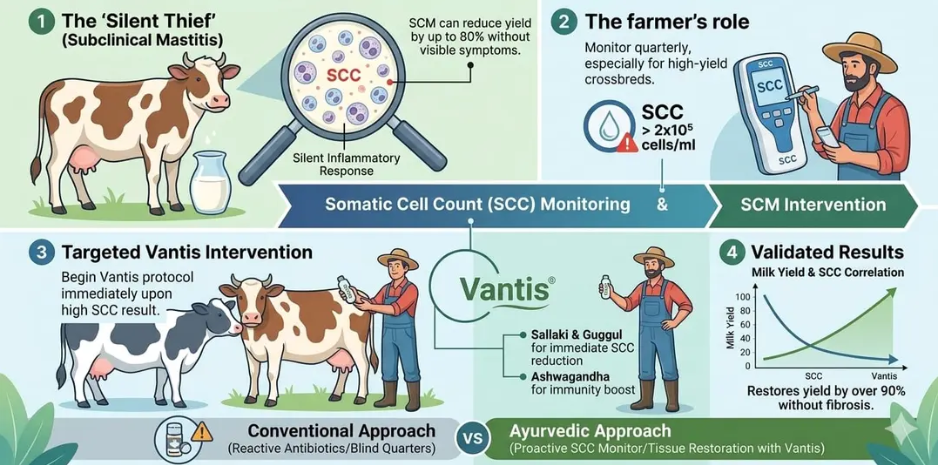
In the Indian context, the Mastitis is broadly classified into clinical and subclinical forms. Clinical mastitis is readily identified by visible abnormalities such as udder swelling, heat, pain, and milk containing clots, flakes, or blood. Subclinical mastitis (SCM), however, presents a more significant challenge because it lacks overt symptoms, remaining largely undetected while causing up to 70-80% of total milk losses.
Recent epidemiological data reveals a staggering disparity in prevalence between these forms. While the prevalence of clinical mastitis in India stands at approximately 11%, subclinical cases reach an alarming 77%, underscoring a persistent and often invisible drain on farm productivity. The susceptibility to mastitis is influenced by several factors, including the breed of the animal, parity, stage of lactation, and environmental management. High-yielding crossbred animals, such as Holstein Friesian (HF) and Jersey crosses, exhibit the highest incidence rates, whereas indigenous cattle and buffaloes demonstrate a higher innate resistance to udder infections.
Impact of Mastitis on Milk Quality and Production
Mastitis induces profound changes in the biochemistry and biophysical properties of milk. When pathogens invade the mammary tissue, they release toxins that damage the secretory alveolar cells, leading to a breakdown of the blood-milk barrier. This damage triggers a systemic and local inflammatory response, characterized by the influx leukocytes—primarily neutrophils—from the blood into the milk thereby increasing Somatic Cell Count (SCC).
Somatic Cell Count: A Key Indicator of Udder Health
The Somatic Cell Count (SCC) is globally recognized as the primary marker for monitoring udder health and milk hygiene. In a healthy bovine udder, the SCC is typically below 2×10⁵ cells/ml, consisting mostly of epithelial cells and resident macrophages. An increase above 2×10⁵ cells/ml generally indicates a bacterial infection in at least one quarter. In the Indian dairy landscape, SCC is increasingly being advocated as a tool for the "Clean White Revolution" to ensure healthy milk production.
Ayurvedic Perspective on Mastitis
According to Ayurveda, mastitis is predominantly considered a disease of Pitta origin, given the hallmark symptoms of heat (Tapaha), redness (Raga), and acute pain (Shoola). The inflammation is seen as a blockage of the Srotas (channels), specifically the Rasavahini (lacticiferous ducts). The accumulation of toxins (Ama) and the invasion of microbial Krimi lead to tissue destruction and abscess formation (Vidhradhi).
The Ayurvedic approach focuses on Pitta-shamaka (Pitta-pacifying) and Krimighna (antimicrobial) herbs to reduce heat and microbial load, along with Shothahara (anti-inflammatory) and Vranaropaka (wound-healing) agents to restore tissue integrity.
Vantis Bolus: An Ayurvedic Mastitis Management Solution
The vanvet company seeing the huge potential, has launched a proprietary formulation (Vantis bolus) containing herbs such as Withania somnifera (Ashwagandha), Boswellia serrata (Shallaki), Curcuma longa (Haridra), Vitex negundo (Nirgundi), Azadirachta indica (Neem) and Ocimum sanctum (Tulsi) along with these it also has Makaradhwaja.
Key Features of Vantis Bolus
1. The Anti-Inflammatory & Pain Management Core
Sallaki (Boswellia Serrata): Acts as a natural NSAID. It inhibits the pro-inflammatory enzymes, reducing the swelling (edema) in the udder without the side effects of synthetic steroids.
Kanchanar Guggul: Traditionally used in Ayurveda for "Granthi" (lumps/cysts). In mastitis, it helps in dissolving the hard fibrous tissue that forms in chronic cases.
Nirgundi (Vitex Negundo): A powerful Vata-hara herb that specifically targets pain and congestion in the mammary tissues.
2. The Antimicrobial & Immune Support
Neem & Tulsi: These provide broad-spectrum antibacterial and antiviral properties. In an article, you can highlight these as the "Natural Antibiotics" that don't leave residues in the milk.
Asvagandha: This is an adaptogen. Since mastitis is often triggered by stress (environmental or physiological), Asvagandha helps the cow’s immune system recover more robustly.
Triphala Guggul: Acts as a blood purifier (Rakta Shodhak), helping to clear the toxins (Ama) out of the lymphatic system.
3. The Potentizers (Mineral-Herbal)
Shuddha Aconite & Makardhwaja: These are Rasa Shastra (iatrochemistry) elements. In small, purified doses, they act as catalysts to speed up the action of the other herbs, thereby fast resolution of the inflammation.
Why Ayurveda is Emerging as a Sustainable Alternative
The rise of antibiotic resistance superbugs has made the existing arsenal of antibiotics dwindling. Making Ayurveda and allied health sciences the effective solution for bovine mastitis. With the good on-field result and quick resolution of mastitis, Vantis has provided a good sustainable alternative for dairy farmers without emptying their pockets.
Zero Withdrawal Period for Residue-Free Milk Production
The potent beneficial feature of the Vantis bolus is the no withdrawal period during the treatment course compared to the antibiotic therapy which usually has 3-5 days withdrawal period for milk, making the milk healthy for human consumption and encouraging residue-free milk production.
Conclusion
For dairy farmers in Salagame Circle and hassan, maintaining udder health while ensuring high-quality milk production is essential for sustainable profitability. With its zero withdrawal period, support for residue-free milk production, and Ayurvedic approach to managing bovine mastitis, Vantis bolus offers a practical and economical alternative to conventional antibiotic therapies. As the dairy industry moves toward safer and more sustainable practices, solutions rooted in Pashu Ayurveda can play an important role in supporting animal welfare, milk quality, and long-term farm productivity.